Prayer Points


Country Information
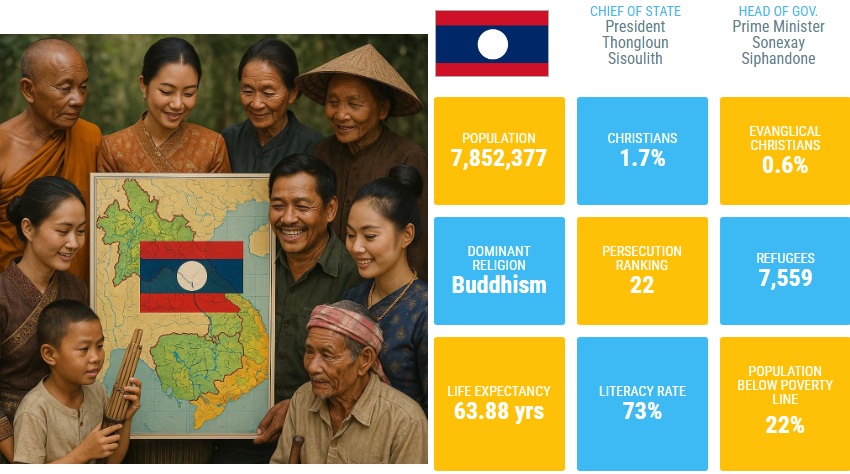
Laos, a landlocked Southeast Asian country, is known for its mountainous terrain, Buddhist heritage, and multi-ethnic society. With roots in the ancient Lan Xang Kingdom (established in the 14th century), Laos has endured colonial rule under France and internal conflict through the 20th century. After gaining independence in 1953, it became a communist state in 1975 under the Lao People’s Revolutionary Party. Theravāda Buddhism, collectivism, and respect for hierarchy heavily shape its culture. Rural communities play a significant role in social life, and traditional customs and festivals remain central to Laotian identity.
Christianity was introduced in Laos during the French colonial period, primarily through Catholic and Protestant missionaries in the late 19th and early 20th centuries. Prominent figures include missionaries like Daniel McGilvary, who extended his work from Thailand into northern Laos, and French Catholic priests who built early missions, schools, and hospitals. The Evangelical Church of Laos and the Lao Catholic Church are officially recognized denominations today. While the Christian population remains small—around 1.5%—its impact is felt through quiet faith communities, small churches, and house fellowships scattered across the country.
Christian teenagers in Laos face intense pressure, especially in rural villages. Converts from Buddhism or animism often face expulsion from their families, exclusion by village authorities, and forced re-education or reconversion efforts. Some youth are pressured into early marriages with non-believers to sever their Christian ties. Government suspicion of foreign influence makes churches wary of outreach or public expressions of faith. Without strong community support, many Christian teens feel isolated, discouraged, and unsure about continuing in their faith—especially when education, social standing, and even food or shelter are at risk for their beliefs.
The Church in Laos is under significant pressure due to government restrictions, social exclusion, and spiritual opposition. Some officials view Christianity as a threat to national unity or as a “foreign religion.” Unregistered house churches are illegal, and Christian gatherings are often monitored. Conversions are discouraged or penalized, especially in rural areas, where village leaders enforce communal conformity. Believers are frequently denied access to community resources, and Christian youth lack mentors due to limited leadership training and fearful or restricted churches. With a growing sense of fear and compromise, the Church risks fading into silence if bold biblical transformation does not occur.
To prevent the decline of Christianity in Laos, Christians must be grounded in Scripture and live out a courageous, communal faith. Parents must prioritize teaching the Word at home (Deuteronomy 11:19), and churches—no matter how small—must become centers of mutual support, prayer, and discipleship (Hebrews 10:24–25). Believers must stop hiding their faith out of fear and instead encourage one another daily (Hebrews 3:13). The Church in Laos must develop a theology of suffering and perseverance (Romans 5:3–4) to prepare the next generation to stand firm amid hardship. Above all, Christians must rekindle a passionate love for Christ that overcomes rejection and fear.