Prayer Points


Country Information
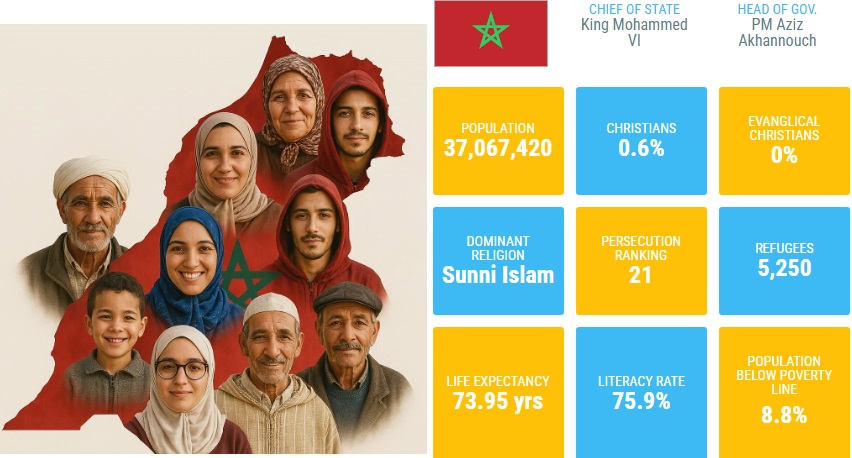
Morocco sits at the northwest corner of Africa and has been a crossroads of peoples — indigenous Berbers (Amazigh), Phoenicians, Romans, Arabs and Europeans — shaped by centuries of trade across the Mediterranean and the Sahara. Its coastal cities (Tangier, Casablanca, Rabat, and historic Marrakesh and Fez) were centers of commerce, scholarship and artisanal culture; Moroccan identity blends Amazigh traditions, Arab-Islamic learning, Sufi religious practices, Iberian and French influences from colonial eras, and a rich material culture of music, cuisine and handicrafts. Archaeology and historical records show that parts of present-day Morocco were integrated into the Roman province of Mauretania Tingitana and that Christianity existed there in antiquity before the spread of Islam in the 7th century.
Christianity arrived in the region in Roman times and persisted in various forms through late antiquity; after the Islamic conquests the scale of indigenous Christianity declined, though Christian communities and missionary activity re-appeared in different eras. In the medieval period Franciscans and other orders sent missions and some martyrs to north-west Africa; the Franciscan tradition remembers the friars sent to preach in Morocco in the early 13th century. In the modern era (19th–20th centuries) Catholic and some Protestant European missions, and more recently expatriate churches and underground house-church movements, have been the main visible Christian presences — while most Moroccan Christians today are either foreign residents or secret/convert believers who meet discreetly because public proselytizing and conversion carry social and legal risks.
Historically notable figures connected to early missionary outreach include St. Francis of Assisi and the small band of friars associated with Franciscan missions to North Africa (the “Franciscan martyrs” sent in 1219), whose story is part of the long memory of Christian witness in the Maghreb. In later centuries, Catholic religious orders (including French and Spanish missionary groups) and some Protestant missionaries from Europe were principal actors in re-establishing Christian institutions among expatriates and in limited outreach. In contemporary times there is no single internationally prominent leader credited with “founding” today’s Moroccan church; rather, modern growth among Moroccan converts has come through small, often underground networks, house churches, and expatriate congregations providing pastoral support.
Young Moroccans who follow Christianity — particularly those from Muslim backgrounds — face layered pressures: family rejection, social ostracism, bullying at school, threats of violence, and risks of formal sanctions when conversion is discovered. Children of known Christians can be singled out for harassment and discrimination that affect schooling, social life and mental health; many believers therefore hide faith or meet only in trusted small groups. These dynamics create isolation and a fragile faith environment for teenagers, who are especially vulnerable to coercion to “return” to social norms.
Several intersecting factors weaken and endanger Christian life in Morocco: the state’s firm identification of national identity with Islam and strict limits on proselytism; strong social pressure from families and communities; and the need for discretion that limits public worship and discipleship. The political dimension compounds this — Morocco’s contested control of Western Sahara has produced international scrutiny, crackdowns on dissent, and a security posture that tightens controls over media and civil society; human-rights groups document censorship, surveillance and suppression of activists in Western Sahara and sometimes across Morocco more broadly. Those same restrictions on free expression and civil society make it harder for minority religious communities to organize openly, publish religious materials, or operate without state scrutiny.