Prayer Points

Country Information
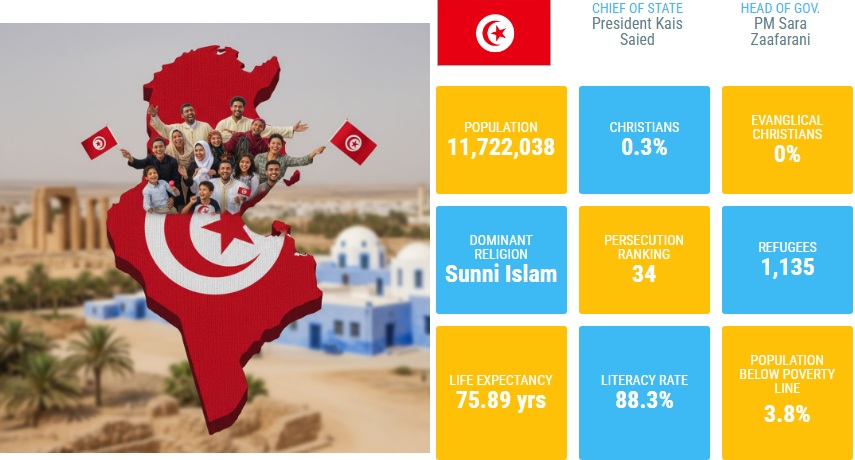
Tunisian history dates back to the ancient kingdom of Carthage (circa 8th century BCE) through various eras, including Roman, Vandal, Byzantine, and Arab-Islamic rule, followed by Ottoman control and a French protectorate. The country gained independence in 1956, and the 2011 Tunisian Revolution ignited the Arab Spring. Today, Tunisia’s culture is a blend of Mediterranean influences, featuring Arabic (with some Berber), significant French impact, rich culinary traditions, musical heritage, and a social life shaped by family connections and festivals like the Carthage Festival.
Christianity has deep roots in present-day Tunisia. Carthage and other towns were hubs for Christianity. Tertullian, Cyprian, and other matyrs were pivotal for the formation of Christianity in the West. Over the centuries, the region became predominantly Muslim following the Arab conquests. Today, Christians make up a small religious minority, which includes historic Catholic communities, expatriate and immigrant congregations.
Tunisian Christian teenagers often experience intense pressure from their families and the society. They are discouraged to practice Christianity openly through exclusion, forced marriages, and difficulties in finding work. In more conservative regions and border areas, there is a real fear of extremist violence. In urban areas, surveillance and social media monitoring can make exercising their faith a risky proposition.
Economic hardship and the pressures of emigration contribute to their stress, as young Christians, like many Tunisian youths, confront high unemployment and the temptation to leave the country, which can fracture local communities and hinder the transmission of faith across generations.