Prayer Points

Climate & Debt Swap Programme February 20, 2026
Mauritania is developing a climate-linked debt swap programme to address financial and environmental challenges. The initiative aims to reduce debt burdens while funding sustainable development projects. Climate change has significantly impacted Mauritania’s ecosystems and livelihoods. This programme aligns with
Continue Reading
Economic Partnership with ECA February 10, 2026
Mauritania has strengthened its partnership with the Economic Commission for Africa to advance development goals. The collaboration focuses on inclusive economic growth and structural transformation. A key priority is creating employment opportunities for young people. Digital transformation is also
Continue Reading
Migration Crackdown Impact in Mauritania January 14, 2026
Mauritania has intensified its efforts to curb irregular migration toward Europe. Authorities have implemented stricter controls along key departure points. As a result, departures to the Canary Islands have significantly decreased. However, migrants are now choosing more distant and
Continue Reading
US-Mauritania Security Cooperation January 27, 2026
Mauritania has strengthened its security capacity through the receipt of military equipment from the United States. This support is part of broader efforts to stabilize the Sahel region, which continues to face extremist threats.The new equipment is expected to
Continue Reading
Fighting Sexual Violence Against Women And Minors In Mauritania February 19, 2025 Sexual violence against women and minors in Mauritania is a widespread issue, exacerbated by cultural taboos and underreporting. Despite statistics showing significant cases of physical and sexual violence, many remain silent due to societal pressures. Commissioner Hindou Mohamed Laghdaf’s brigade Continue Reading

Country Information

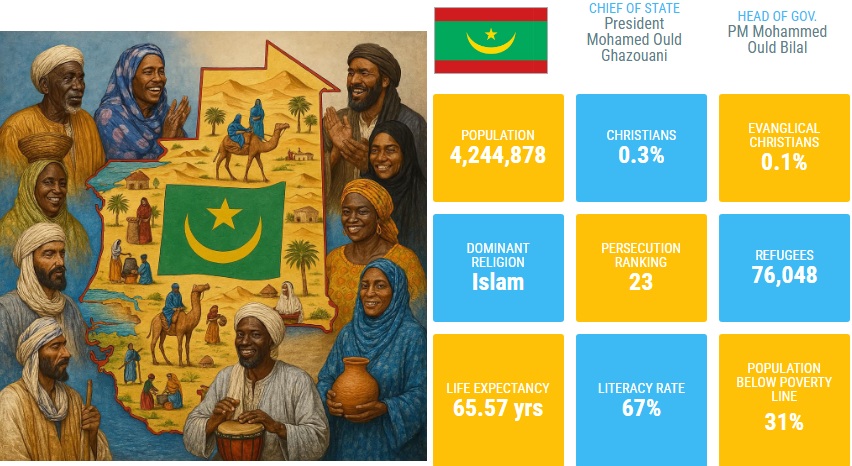
Mauritania, located in Northwest Africa, has a history shaped by ancient Berber tribes, Arab conquests, and centuries of Islamic influence. Since its independence from France in 1960, the country has been defined by its deep Islamic identity, with Islam being the official state religion. One of the most painful aspects of Mauritania’s history is its long entanglement with slavery. Though officially abolished in 1981 and criminalized in 2007, slavery—particularly hereditary slavery tied to ethnic and caste systems—remains a deep scar on society, affecting generations of families and creating divisions that still impact culture today. Mauritania’s culture blends Arab, Berber, and sub-Saharan African traditions, marked by desert nomadism, griot oral poetry, and traditional music.

Christianity has always been a minority faith in Mauritania, introduced through early Catholic missions during the French colonial period and sustained by a few expatriate and underground communities. Some Christian leaders, including Catholic missionaries and Protestant workers, visited the country in the 20th century to plant seeds of the Gospel. Yet, due to strict anti-conversion laws and persecution, Christianity has remained fragile. Today, Christian teenagers in Mauritania face intense struggles, including societal rejection, isolation, and fear of government punishment. Disunity among Christian Believers has also weakened the faith, often caused by denominational divisions, fear of persecution, and lack of discipleship. If Mauritania’s Christians are to survive, they must return to biblical unity (John 17:21), strengthen disciples in Christ (Colossians 2:6-7), and cultivate the courage to face persecution (2 Timothy 1:7).