Prayer Points


Country Information
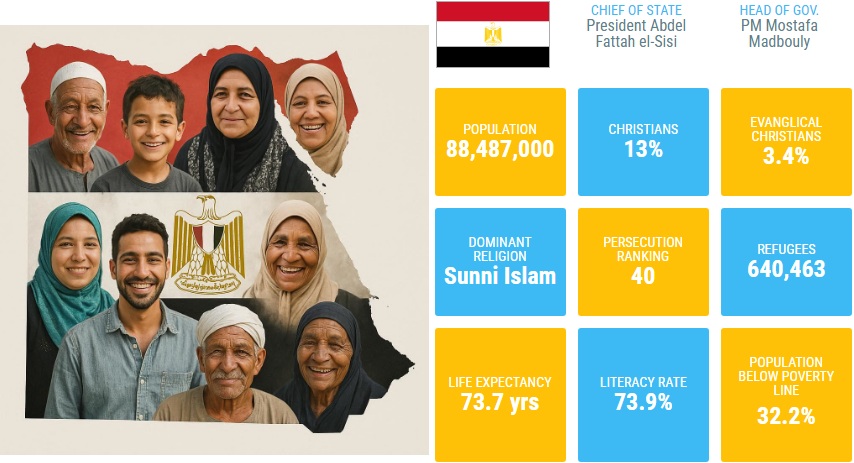
Egypt is an ancient land whose history stretches from Pharaonic civilizations along the Nile through Hellenistic, Roman, and Byzantine rule to the Arab-Islamic era and modern nationhood. Its culture blends pharaonic monuments, Coptic art and liturgy, Arabic language and Islamic public life; music, food, family ties, and festivals reflect that layered heritage. Christianity arrived in Egypt very early: Church tradition credits Mark the Evangelist with bringing the gospel to Alexandria in the first century, and Alexandria soon became a major center of Christian theology and learning (Clement, Origen, Athanasius) and of the monastic movement (Anthony the Great, Pachomius). Over centuries, Egyptian Christians — the Copts — developed a distinct liturgy, theology, and monastic culture that influenced the wider Church.
Today, Egyptian Christian teenagers face many pressures: social discrimination at school or in some workplaces, stigma and exclusion in mixed communities, fear of sectarian violence or family pressure to conform, online secularizing influences, and the lure of emigration as a safer, more prosperous option. These forces can sap identity and hope: young people sometimes feel their faith is either privatized or impractical, and community supports (youth groups, theological education, apprenticeships) are uneven.
The Egyptian Church is under threat from several sources: targeted persecution and attacks on Coptic communities by extremist groups; structural discrimination or weak legal protections in some contexts; high emigration of believers seeking safety or opportunity; internal problems such as corruption, poor pastoral formation, theological fragmentation, and failure to meaningfully engage modern youth. Persecution of Coptic Christians — including attacks on Churches and violence targeting believers — has both a real human cost and a chilling effect that pushes families to keep faith private or to leave.