Prayer Points


Country Information
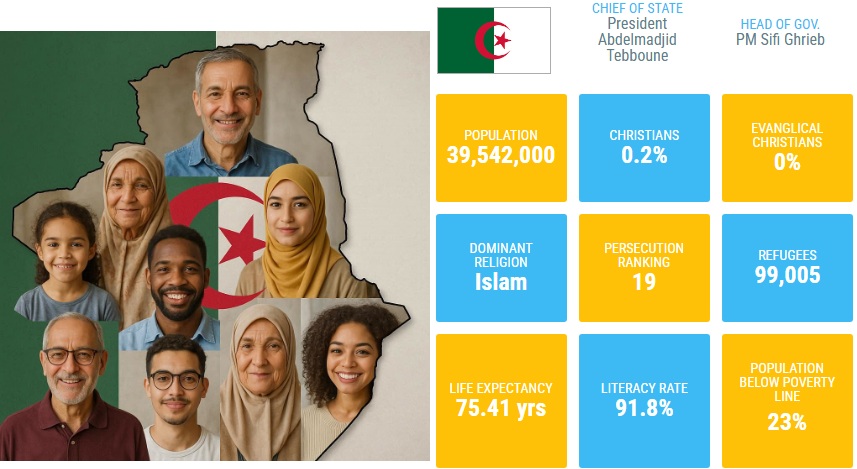
Algeria sits on the southern shore of the Mediterranean and is North Africa’s largest country. Its long history includes Phoenician and Roman cities, centuries of Amazigh (Berber) and Arab rule, Ottoman suzerainty, and 130 years of French colonization that ended after a hard-fought war of independence in 1962. Modern Algeria’s culture blends Arab-Islamic and Amazigh traditions, strong family and village ties, French linguistic and legal legacies, and the economic centrality of oil and gas. Political life is shaped by independence-era nationalism, one-party rule, and episodes of unrest that continue to influence social trust and civic life.
Christianity in Algeria returns to the Roman era (the province of Numidia). North Africa was an early center of Latin Christian thought; the most famous local figure is Augustine of Hippo (born in Thagaste, served as bishop at Hippo Regius — modern Annaba), whose sermons and books shaped Western Christianity for millennia. After the Arab-Islamic centuries, the Christian presence contracted; it reappeared in larger institutional form during French rule (Catholic dioceses, missions, and settler communities). After independence (1962), most European Christians left, and the modern Christian community is much smaller and mainly composed of Protestant congregations, foreign nationals, and a limited number of Algerian converts.
Young Algerian Christians — especially Algerian nationals who have become Christian — face several overlapping pressures: strong social and family expectations to remain Muslim; legal restrictions that criminalize some forms of proselytizing and tightly regulate non-Muslim organizations; occasional police raids, forced closures of meeting places, or harassment; social stigma and bullying at school; isolation because local Christian youth groups are small; and the broader insecurity and memory of violence from the 1990s that makes overt religious difference risky in some communities. International monitors document government restrictions and social pressure that raise particular risks for converts and for young people trying to live out a Christian identity publicly.