Prayer Points
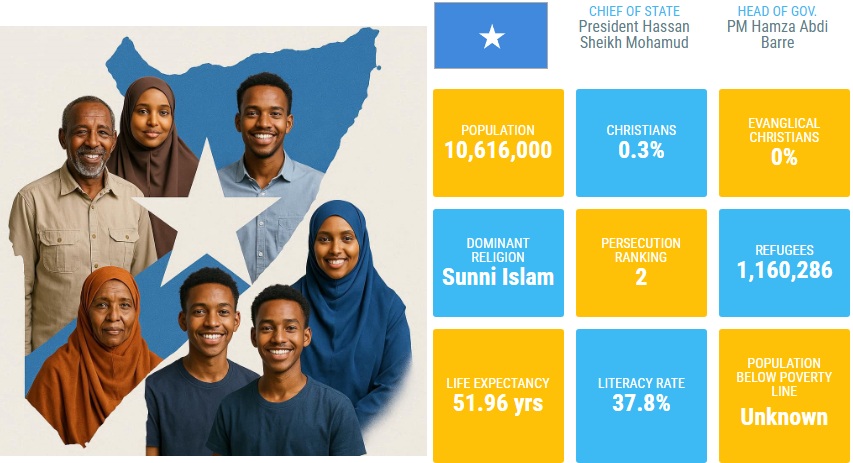
Somalia is a country on the Horn of Africa with a long, layered history: maritime trading networks connected its coast to Arabia and the Indian Ocean for millennia; inland, pastoralist clans shaped social life and law; in the 19th and 20th centuries colonial boundaries (British in the north, Italian in the south) and post-independence state-building, civil war, and recurring droughts profoundly shaped modern Somalia. Somali culture is strongly clan-based and Islamic in identity—oral poetry, rich pastoral and seafaring traditions, and hospitality are central. Christianity has always been a minimal presence in Somalia.
Christian influences in the wider Horn of Africa and some missionary and humanitarian activity during the colonial and post-colonial eras, Somalia’s overwhelmingly Muslim identity, and later decades of conflict have meant there are very few public, historic churches or long-standing national Christian institutions inside the country.
Because formal, sustained Christian institutions inside Somalia are minimal, there are not many widely documented “founding” leaders in the same way as in countries with long public churches; instead, Christian presence has come from regional Christian communities in neighboring Ethiopia and Kenya, visiting missionaries and faith-based aid workers from Catholic and Protestant agencies during the colonial and humanitarian eras, and a small number of Somali converts and underground house-church leaders who have quietly formed Christian fellowship.
Somali Christian teenagers today face severe, daily struggles: they often must hide their faith from family and clan to avoid social ostracism, forced conversion back to Islam, or even violent persecution; youth discovered as Christians can be targeted by extremist groups (notably Al-Shabaab) or by community pressure, lose access to education or family support, and experience deep isolation because there are almost no public churches, youth groups, or safe spaces for discipleship. Mental-health burdens, lack of trusted mentors, and the need to practice faith in secrecy make formation (learning Scripture, Christian community, leadership) extraordinarily difficult for the next generation.


Country Information