Prayer Points

Country Information
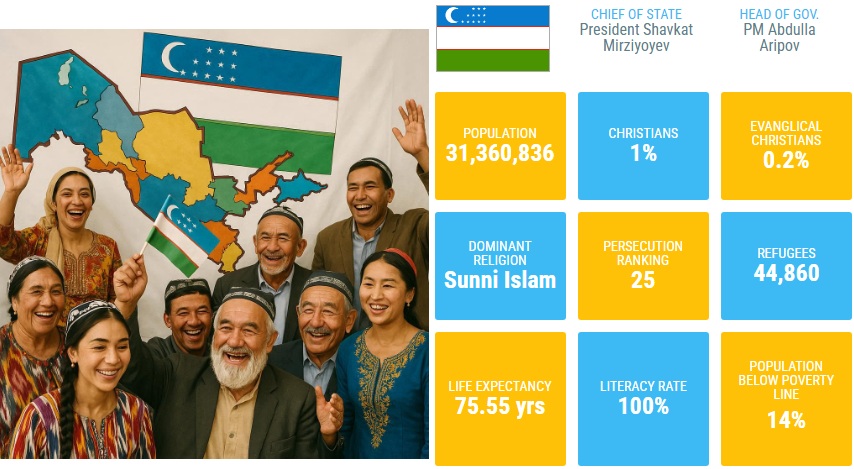
Uzbekistan, once a thriving hub of the Silk Road, holds a deep and diverse history marked by Persian, Turkic, Mongol, and Russian influences. After gaining independence from the Soviet Union in 1991, the country began shaping its own cultural identity rooted in Islam, which remains the dominant faith. The Uzbek culture values family honor, community loyalty, and hospitality, yet traditionalism often makes it difficult for minority faiths to thrive. Christianity first reached this land through Nestorian missionaries as early as the 7th century, but it faded under Islamic dominance and Soviet atheism. Modern Christianity was reintroduced through Russian Orthodox settlers and later Protestant missions during the 19th and 20th centuries. Pioneering Christian leaders, including Orthodox priests and Central Asian evangelists, helped re-establish small Christian communities across cities like Tashkent and Samarkand.
Today, Uzbekistan’s Christian teenagers face immense struggles. Many converts from Islam are excluded by their towns and villages, expelled from families, or forced to reconvert under extreme social pressure. Young Christian women are especially vulnerable to bride kidnapping and forced marriages, used as tactics to erase their Christian identity. Churches are often surveilled, gatherings restricted, and faith-based materials banned. The Church is under threat due to the lack of religious freedom, fear of persecution, and generational drift where youth, seeking safety and acceptance, abandon their beliefs. To prevent the decline of Christianity, Uzbekistan’s believers must hold fast to biblical principles—remaining steadfast in unity, forgiveness, and discipleship. They must mirror early Church courage as seen in Acts, standing firm in truth and love even amid rejection.