Pray for pastors, church leaders, and Christian workers to receive wisdom, sound biblical training, encouragement, and the resources needed to nurture new believers. Ask God to strengthen Christian fellowship and discipleship.
for the equipping of the saints for the work of ministry, for the edifying of the Body of Christ,
Pray for children, students, and young adults to encounter truth, hope, and the love of Christ. Ask God to provide appropriate opportunities for them to explore the Bible and for Christian families to raise their children in faith.
But when Jesus saw it, He was greatly displeased and said to them, “Let the little children come to Me, and do not forbid them; for of such is the Kingdom of God.
Pray For Those Without a Clear Identity
Uzbekistan has made significant progress in reducing statelessness, but around 16,000 people were still recorded as stateless at the end of 2025.
Pray for people whose legal identity, documentation, or citizenship remains uncertain.
For we are aliens and pilgrims before You,
As were all our fathers;
Our days on earth are as a shadow,
And without hope.
1 Chronicles 29:15
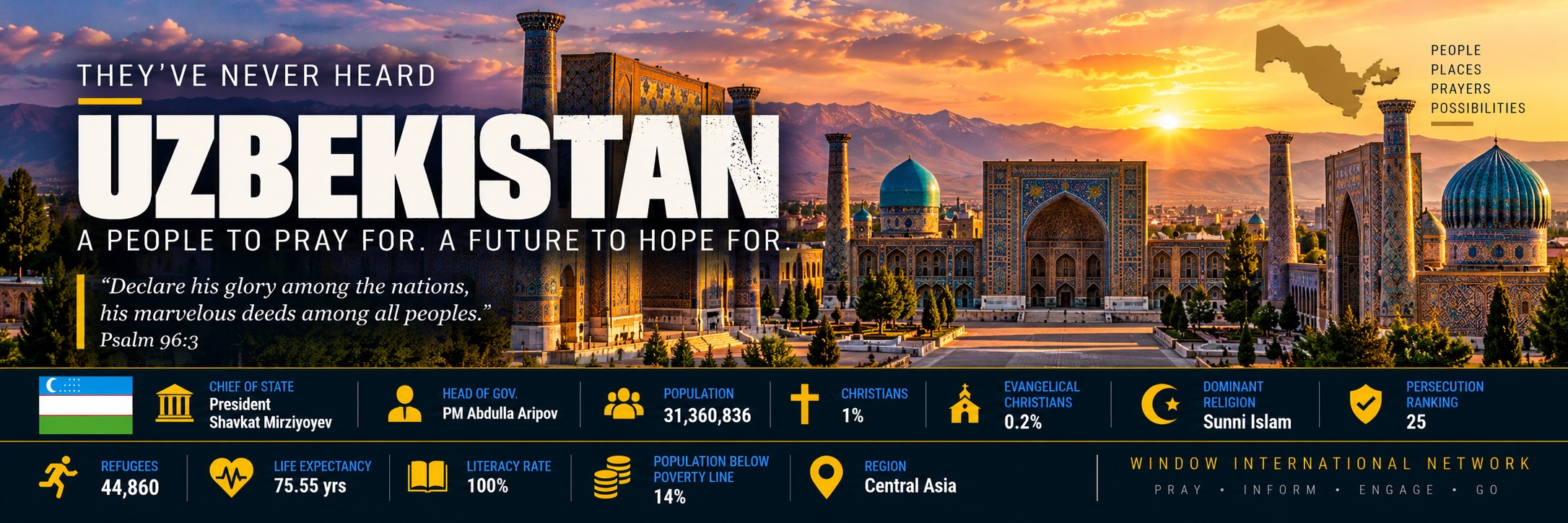
Capital: Tashkent
Primary language: Uzbek
Other languages: Russian, Tajik, Kazakh, Karakalpak, and other minority languages
Prayer focus: Uzbek people, young adults, minority communities, Afghan families, isolated Christian Believers, and people seeking spiritual truth
Uzbekistan is the most populous country in Central Asia. It is a landlocked country whose borders touch Kazakhstan, Kyrgyzstan, Tajikistan, Afghanistan, and Turkmenistan. Tashkent is its capital and largest city. The country contains an extraordinary mixture of landscapes and cultures: the Kyzylkum Desert, fertile areas around the Amu Darya and Syr Darya, mountain regions in the east, and historic cities such as Samarkand, Bukhara, and Khiva.
For centuries, Uzbekistan stood at the crossroads of the Silk Road. Traders, scholars, languages, and religions passed through its cities. Today, millions of people live in a country carrying that extraordinary heritage into a rapidly changing modern world.
The Uzbeks form the overwhelming majority of the population and speak Uzbek, a Turkic language. There are significant Tajik communities, particularly around historic cities and parts of the country’s east. Karakalpaks have their own language and cultural identity, especially in the autonomous Republic of Karakalpakstan. Kazakhs, Kyrgyz, Tatars, Russians, Koreans, and other communities also make up Uzbekistan’s population.
Some communities are concentrated in particular regions; others live alongside one another in the country’s rapidly expanding cities. There are also people whose lives have been shaped by displacement. At the end of 2025, UNHCR estimated that around 7,700 Afghans in Uzbekistan were people in need of international protection, while about 16,000 people were recorded as stateless.
Today, Uzbekistan is once again experiencing rapid change. Cities are growing, technology is transforming communication, and younger generations are increasingly connected to a world beyond their borders.
Pray that this new connectivity will create opportunities for people to encounter the Gospel.
Uzbekistan has a deep religious heritage, overwhelmingly Muslim, yet many people have little meaningful opportunity to investigate Christianity. Religious activity remains subject to significant legal controls.
1. Government restrictions and legal barriers
One of the most significant challenges is regulating religious activity. Uzbekistan’s laws impose registration requirements on religious communities and restrict missionary activity, proselytism, and religious education outside authorized settings. Religious literature is also subject to state controls. In its 2026 assessment, the U.S. Commission on International Religious Freedom reported continued penalties against people engaged in peaceful religious expression and religious education.
These restrictions can make it difficult for Christians to organize gatherings, establish congregations, distribute Christian materials, and share their faith openly. As a result, smaller fellowships face particular obstacles in obtaining official registration.
2. Strong family and cultural ties
For many Uzbek people, Islam is more than a set of religious beliefs; it is closely woven into family relationships, community life, marriage traditions, and national identity. Choosing to follow Jesus may therefore be perceived as rejecting one’s heritage or bringing shame upon the family.
People who become Christians from a Muslim background may face pressure to return to their former faith. As a result, some experience rejection, isolation, or restrictions on their freedom to meet with other believers. The consequences can be especially difficult for people living in rural communities where extended-family and community relationships play a central role.
The challenge: Evangelism must communicate that following Christ is a response to God’s truth and grace, not an expression of hostility toward one’s family or people.
3. Limited opportunities to hear and understand the Gospel
Access to Christian teaching and resources in a person’s heart language remains an important concern. Uzbek is the principal language for much of the population, while Russian and several regional languages are also spoken. Christian resources that are accessible, culturally meaningful, and understandable to local communities are essential for communicating the Gospel clearly.
Restrictions on religious literature can make the distribution and use of Bibles, Christian books, and discipleship materials difficult. Beyond initial exposure to the message, new Christian Believers also need opportunities to study Scripture, ask questions, grow in faith, and receive sound biblical teaching.
4. Fear, surveillance, and social pressure
The possibility of being reported to authorities, questioned, fined, or subjected to social consequences can discourage Christians from sharing their faith. Reports of pressure on unregistered congregations and scrutiny of Christian activities contribute to an atmosphere of uncertainty.
This environment can encourage believers to keep their faith private. As a result, new Christians may hesitate to speak about their convictions, invite others to explore the Bible, or participate openly in Christian fellowship. Evangelism consequently requires wisdom, courage, patience, and a careful understanding of local laws and circumstances.
5. Discipleship and the formation of local churches
Helping someone encounter Christ is only the beginning. New believers need biblical teaching, pastoral care, fellowship, and encouragement to grow into mature disciples. Yet restrictions on religious gatherings, unregistered activities, and unauthorized religious education can complicate these essential aspects of church life.
Church leaders also need wisdom to nurture Christian Believers, equip them for service, and build healthy Christian communities within the law. In addition, the need is not simply for more people to hear about Jesus, but for those who respond to Him to be strengthened in their faith and supported through the challenges that may follow.
6. Reaching young people and future generations
Young people are growing up amid changing social expectations, digital communication, and the influence of both traditional values and global culture. These changes create opportunities for questions about meaning, identity, forgiveness, hope, and the purpose of life. At the same time, sharing religious content and conducting religious instruction can be subject to legal restrictions.
Children and young people who become interested in Christianity may need safe, appropriate opportunities to explore Scripture and ask honest questions. At the same time, families and communities may react strongly if a young person expresses interest in another faith.
The challenge is to communicate Jesus’ message with clarity and compassion while respecting families, safeguarding young people, and complying with applicable laws.
Why have they never heard?
Although Uzbekistan has a Christian minority, the existence of churches does not mean that every community has meaningful access to the Gospel. Cultural barriers, restrictions on evangelism, limited access to Christian resources, and the social cost of conversion can all hinder people from hearing and responding to the message of Jesus.
Behind these challenges are individuals and families who need opportunities to encounter the biblical account of Christ, understand His teachings, and explore the Christian faith without coercion or fear.
The task of evangelism is therefore both spiritual and relational: to make the Gospel known, to demonstrate Christ’s love through genuine service, to strengthen local Christian Believers, to pray for greater freedom to practice and share faith, and to ask who still needs to hear and respond.
Pray that people throughout Uzbekistan will have meaningful opportunities to hear and understand the message of Jesus. Ask God to open doors for faithful Christian witness and access to Scripture.
meanwhile praying also for us, that God would open to us a door for the word, to speak the mystery of Christ, for which I am also in chains,
Strengthen those who follow Christ
Pray for Uzbek Christians, especially those who have come from Muslim backgrounds and face rejection or pressure from relatives and friends. Ask the Lord to give them courage, wisdom, perseverance, and opportunities to demonstrate His love.
Have I not commanded you? Be strong and of good courage; do not be afraid, nor be dismayed, for the Lord your God is with you wherever you go.”
Pray for freedom of conscience
Therefore I exhort first of all that supplications, prayers, intercessions, and giving of thanks be made for all men, for kings and all who are in authority, that we may lead a quiet and peaceable life in all godliness and reverence.
Heavenly Father,
We lift up the nation of Uzbekistan into Your loving Hands. We pray for the Uzbek people, that their hearts may be open to the truth and love of Jesus Christ and that they may have opportunities to hear and understand the Gospel. Lord, strengthen the small Christian community in Uzbekistan, especially those who face rejection, persecution, or pressure from their families and communities because of their faith.
Grant them courage, wisdom, and perseverance, and surround them with fellowship and spiritual encouragement. We pray for pastors, church leaders, and Christian workers, asking You to provide opportunities to share Your Word, disciple new Christian Believers, and establish strong communities of faith.
Father, guide the nation’s leaders to protect freedom of religion and belief and to open doors for the peaceful distribution of Scripture and access to biblical teaching. Remember the children and young people of Uzbekistan; may they discover the hope, peace, and purpose found in You. We pray for families to experience Your love, for barriers of fear and misunderstanding to be overcome, and for relationships between people of different faiths to be marked by mutual respect and compassion.
May Your Holy Spirit move throughout Uzbekistan, bringing hearts to seek You, strengthening those who already believe, and raising up faithful witnesses to share the good news of Salvation. May the light of Christ shine throughout this nation, and may Your Will be accomplished among its people.
In the mighty Name of Jesus Christ, we pray. Amen.

