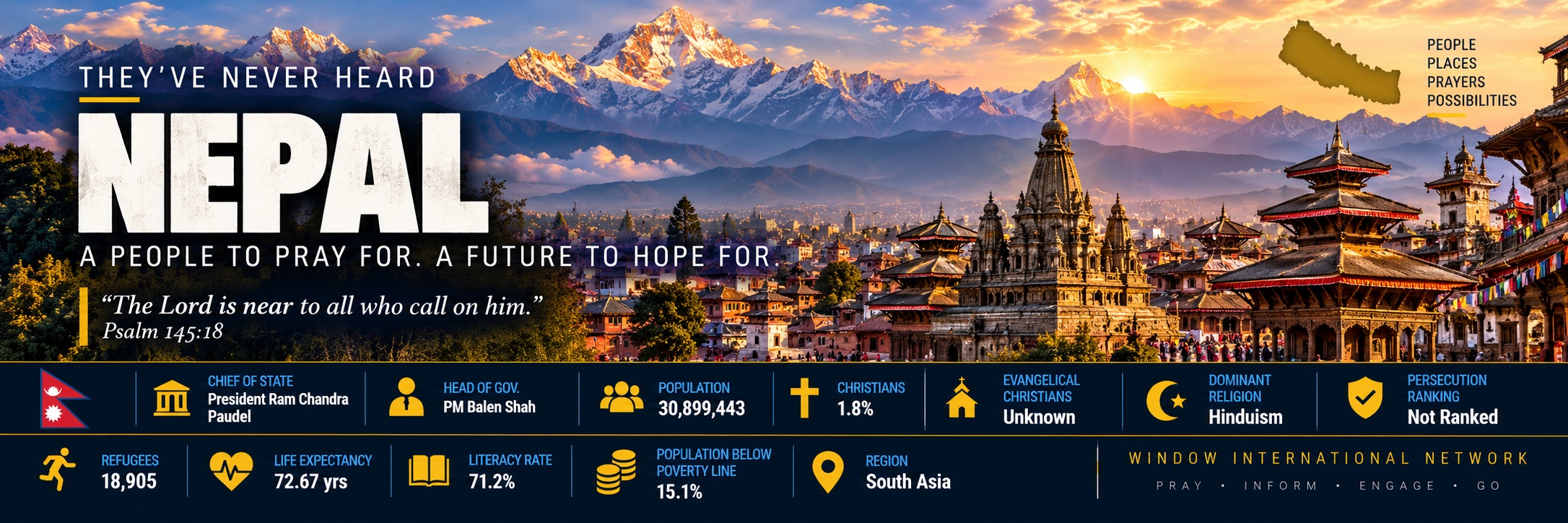
Pray For Nepal’s Christians
Pray for pastors, church leaders, families, and young Christian Believers. Pray for wisdom when sharing their faith.
For the Lord is good; His mercy is everlasting, And His truth endures to all generations.
Psalm 100:5
Pray For The Marginalized
Pray for dignity, justice, opportunity, and genuine Christian fellowship. Pray for churches that reflect the equal worth of every person created by God.
He raises the poor out of the dust, And lifts the needy out of the ash heap,
Psalm 113:7
Pray For Those Who Leave Home
Pray for workers separated from spouses, children, and parents. Pray for young adults experiencing life far from home. Pray that migration will create unexpected opportunities for people to encounter Christians and hear the Gospel.
Commit your way to the Lord, Trust also in Him, And He shall bring it to pass.
Psalm 37:5
Capital: Kathmandu
Primary language: Nepali
Other languages: Maithili, Bhojpuri, Tharu, Tamang, Newar, Magar, Gurung, Sherpa, and many others
Major religious traditions: Hinduism and Buddhism
Nepal is a culturally and religiously diverse nation nestled in the Himalayas, between India and China. Hinduism is the predominant religion, while Buddhism has deep historical and cultural roots. The country is also home to Muslims, Christians, followers of traditional beliefs, and communities whose spiritual practices combine different religious and cultural influences.
Christianity has grown in Nepal over recent decades, and local churches play an important role in the lives of many believers. Nevertheless, sharing the Gospel continues to present significant challenges. Religious identity is often closely connected to family heritage, caste, community belonging, and long-established traditions. For some Nepalese people, becoming a Christian can be perceived as rejecting their family’s beliefs and cultural identity.
Nepal’s Constitution recognizes freedom of religion but prohibits converting another person from one religion to another and engaging in acts that undermine or jeopardize another person’s religion. These constitutional provisions, together with criminal laws against religious conversion and certain forms of religious activity, create a challenging environment for Christian evangelism. The result is a complex landscape in which churches seek to share their faith while navigating legal uncertainty, social opposition, and the needs of new Christian Believers.
Nepal stretches from the lowland Terai plains to the highest mountains on earth. The country is home to an extraordinary range of peoples and languages, from communities living along the Indian border to Himalayan peoples whose villages sit at great elevations. Kathmandu is the country’s political and cultural center, but Nepal’s story cannot be understood from the capital alone.
There are villages that can only be reached after hours or days of travel. There are mountain communities separated by geography. There are cities filled with students and migrant workers. There are families living in the Terai whose cultural world is very different from that of the high Himalayas.
Nepal contains a remarkable mosaic of peoples. The Brahmin and Chhetri communities form large parts of the population. The Newar people have a particularly important historical and cultural connection with the Kathmandu Valley. The Tamang, Gurung, Magar, Rai, Limbu, Sherpa, Tharu, Dalit, and many other communities each have their own histories, languages, and traditions.
In the south, the Madhesi communities maintain strong cultural and linguistic connections with northern India. In the mountains are communities whose lives have been shaped by altitude, migration, trade, and generations of Himalayan traditions. Nepal’s diversity means that there is no single cultural pathway by which the Gospel will reach everyone.
Pray for Christ to be made known within each community, language, and generation.
Legal restrictions on religious conversion
Strong Hindu and Buddhist cultural traditions
Family rejection and social pressure
Caste discrimination and social divisions
Limited access to Christian resources and biblical teaching
Reaching remote mountain and rural communities
Misunderstanding and negative perceptions of Christianity
Registration and organizational challenges
Pray For The Many Languages Of Nepal
Pray for Scripture and Christian resources in the languages people speak within their homes and communities. Pray for translators, writers, and teachers who can communicate the Gospel with both accuracy and cultural understanding.
A word fitly spoken is like apples of gold
In settings of silver.
Proverbs 25:11
Pray For The Himalayan Communities
Pray for villages separated by difficult terrain and long distances. Pray for families dependent on farming, livestock, tourism, and mountain trade. Pray for God’s protection over these communities and for opportunities for the Gospel to reach them.
The Lord shall preserve your going out and your coming in. From this time forth, and even forevermore.
Psalm 121:8
Pray For The Terai
Pray for farmers, traders, families, students, and communities living along the borderlands. Pray for spiritual renewal to take root in the plains.
The wilderness and the wasteland shall be glad for them, And the desert shall rejoice and blossom as the rose;
Isaiah 35:1
Pray For Refugees And Displaced People
Pray that refugees will encounter practical compassion and the hope of Christ.
“You shall neither mistreat a stranger nor oppress him, for you were strangers in the land of Egypt.
Exodus 22:21
Heavenly Father,
We lift up the nation of Nepal into Your loving and sovereign hands. We pray for the people of this beautiful Himalayan nation, that their hearts may be open to Your truth and that they may encounter the saving grace and unconditional love of Jesus Christ. Lord, we ask You to strengthen the Christian community in Nepal, especially those who face rejection, discrimination, or pressure from their families and communities because of their faith.
Grant them courage, wisdom, and perseverance, and surround them with loving fellow believers who will encourage them in their walk with You. We pray for pastors, church leaders, missionaries, and Christian workers who faithfully serve the people of Nepal. Equip them with spiritual discernment, sound biblical teaching, and the resources they need to nurture new believers and establish strong, Christ-centered communities.
Father, we pray for the nation’s leaders and authorities, that they will uphold freedom of conscience and protect every person’s right to practice their faith peacefully. May legal restrictions that hinder peaceful religious expression be addressed with justice and wisdom. We pray for people from every caste, ethnic group, and social background, that prejudice, discrimination, and division will give way to dignity, equality, and genuine love for one another.
Lord, open doors for the Gospel to reach remote mountain villages, rural communities, and people who have had little opportunity to hear the message of Jesus. Provide Scripture and biblical teaching in the languages people understand, and raise up faithful Nepalese Christian Believers who will share Your Word with humility, compassion, and integrity. We pray for those who are searching for hope, meaning, forgiveness, and peace; may they find opportunities to explore the Christian faith freely and make decisions according to their conscience.
Protect new Christian Believers, strengthen their families, and provide them with fellowship, discipleship, and spiritual maturity. May the churches of Nepal be known for their unity, holiness, compassion, and service to all people, regardless of their religious background. Holy Spirit, move throughout Nepal, bringing healing to broken relationships, hope to discouraged hearts, wisdom to leaders, and strength to Your people. May the light of Christ shine from the Himalayan mountains to the valleys and cities, and may many come to know Your love through the faithful witness of Your Church.
In the mighty and precious Name of Jesus Christ, we pray. Amen.

