Pray for Saudi families
Father, awaken a hunger for truth among Saudi families. Give people the freedom to ask questions and the courage to seek You sincerely.
But from there you will seek the Lord your God, and you will find Him if you seek Him with all your heart and with all your soul.
Deuteronomy 4:29
Pray for young Saudis
Father, reach Saudi Arabia’s young generation. Meet them through questions about purpose, identity, justice, and eternity. Give them access to the truth and people who will patiently walk with them.
Let us hear the conclusion of the whole matter:
Fear God and keep His commandments,
For this is man’s all.
Ecclesiastes 12:13
Pray for Christians living and working in Saudi Arabia
Father, give Christian Believers wisdom and courage. Help them live with integrity, love their neighbors, and recognize opportunities to point people toward Jesus while acting with appropriate discretion.
Those who are wise shall shine
Like the brightness of the firmament,
And those who turn many to righteousness
Like the stars forever and ever.
Daniel 12:3
Pray for expatriate communities
Lord, watch over the millions of people living away from their countries of origin. Give them protection, dignity, and friendship. Use Christian Believers among them as witnesses to Christ.
And He has made from one blood every nation of men to dwell on all the face of the earth, and has determined their preappointed times and the boundaries of their dwellings,
Acts 17:26
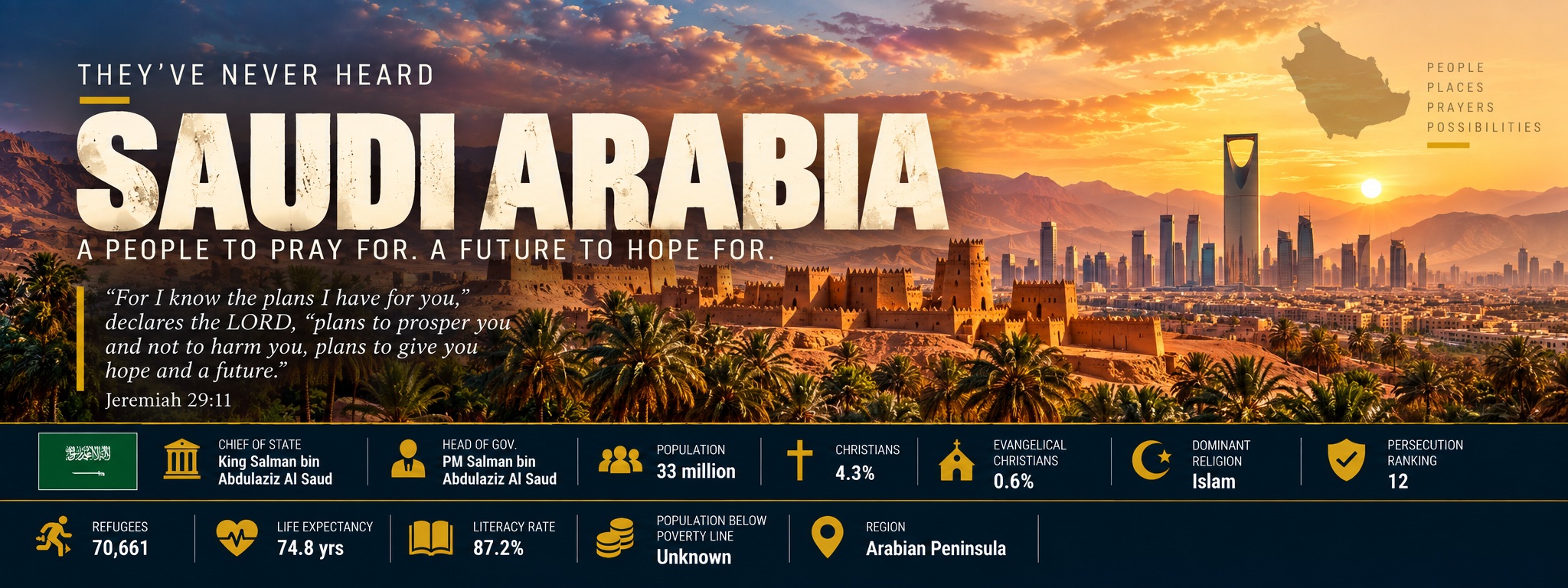
Capital: Riyadh
Region: Arabian Peninsula
Population: 36,973,555 (2025)
Official Language: Arabic
Dominant Religious Tradition: Islam
Identified People Groups: 28
Unengaged and Unreached People Groups: 19
Population within Unengaged and Unreached Groups: Approximately 5.63 million
Engaged but Unreached People Groups: 8
Life Expectancy: 79 years (2024)
Current demographic data places Saudi Arabia’s population at approximately 37 million. People-group data identifies 28 distinct groups, including 19 classified as unengaged and unreached and another eight classified as engaged yet unreached.
That means the challenge is not simply reaching Saudi Arabia geographically.
It is reaching people within Saudi Arabia.
Saudi Arabia is much more culturally varied than a single national identity might suggest.
There are communities associated with different regions and dialects, including:
- Najdi Arabs of the central region
- Hijazi Arabs around the western region
- Bedouin communities
- Eastern Arabian communities
- Southern Arabian communities
- Shia communities in the Eastern Province
- Numerous expatriate communities from Asia, Africa, and the wider Middle East
The Saudi Arab population is estimated at approximately 13 million, with Najdi Arabic as its primary language and Sunni Islam as its dominant religious tradition.
The Hijazi Saudi Arab community is estimated at approximately 12 million and has its own Hijazi Arabic identity and regional heritage.
These are enormous populations.
Yet both remain classified as unreached, with evangelical Christian presence below 2%.
The Desert People
Among Saudi Arabia’s most distinctive communities are the Bedouin Arabs.
Approximately 1.44 million Bedouin Arabs live in Saudi Arabia. Their cultural heritage is connected to tribal relationships, pastoral traditions, and the deserts of the Arabian Peninsula. Their primary language is Najdi Arabic, and the community is predominantly Sunni Muslim. Current field data classifies them as unengaged and unreached.
For centuries, desert communities developed ways of life adapted to an environment where water, distance, and mobility shaped everything. Today, many Bedouin communities have become more settled, but tribal and family identity remain important.
Praying for them means praying for families, relationships, and generations.
The Western Region
The Hijaz holds a particularly significant place in Saudi Arabia’s history and culture. Cities such as Jeddah, Mecca, and Medina are located in this region, which has historically been a crossroads for pilgrims, merchants, and travelers. The Hijazi Arab community has developed its own linguistic and cultural identity, distinct from the Najdi traditions of central Saudi Arabia.
For centuries, people have arrived in the Hijaz from across the wider Muslim world. That makes this region a place where cultures and languages have met for generations.
The Central Region
Central Saudi Arabia has its own cultural character, strongly associated with the Najdi Arab identity.
The Saudi Arab community, identified in current people-group research, primarily speaks Najdi Arabic and has approximately 13 million members. It is classified as engaged yet unreached. The sheer size of this population means that prayer cannot focus only on isolated villages or remote communities.
Pray that today’s relationships may become pathways through which people encounter the gospel.
The Expatriate Dimension
Saudi Arabia is also home to millions of foreign workers and residents. People from South Asia, Southeast Asia, Africa, and other parts of the Middle East live and work throughout the country.
This creates another layer to prayer. A Christian worker may encounter someone from a completely different nation while living in Saudi Arabia. A workplace can become a place of friendship. A shared meal can become an opportunity to listen. A conversation during a long workday can become the beginning of a spiritual journey. For some people, the person sitting beside them may be the first Christian they have ever known personally.
Faith and family are closely connected
Religious identity is deeply woven into family and community life. For someone considering following Jesus, the decision can affect relationships far beyond the individual.
Christian witness is highly restricted
Saudi Arabia does not have an ordinary public church environment comparable to countries where Christian congregations openly operate. Christians, therefore, often have to exercise considerable wisdom and discretion in expressing their faith.
Language matters
Arabic is not simply one uniform form of communication. Najdi Arabic and Hijazi Arabic have distinct regional identities, vocabularies, and cultural associations. Communicating Christ effectively requires understanding both the people and the language.
Tribal and family networks are powerful
For many communities, relationships extend across large networks of relatives and clans. A gospel decision can therefore have consequences for an entire family network.
Some communities remain extremely isolated
The Bedouin communities illustrate this challenge. Even when physical isolation has decreased, cultural and relational barriers can remain significant.
Pray for the Najdi Arabs
Lord, reveal Yourself among the Najdi people. Open hearts to understand the message of Scripture and provide opportunities for people to encounter the gospel through trustworthy relationships.
Give me understanding, and I shall keep Your law;
Indeed, I shall observe it with my whole heart.
Psalm 119:34
Pray for the Hijazi Arabs
Father, let Your light reach the Hijazi people. Guide those who are searching and create unexpected opportunities for them to encounter Jesus.
Oh, send out Your light and Your truth!
Let them lead me;
Let them bring me to Your holy hill
And to Your tabernacle.
Psalm 43:3
Pray for the Bedouin communities
Lord, let spiritual life spring up among desert communities. Reach families and tribal networks with the good news, and raise up witnesses who understand their culture and way of life.
The wilderness and the wasteland shall be glad for them, And the desert shall rejoice and blossom as the rose;
Isaiah 35:1
Pray for the Eastern Province
God of truth, meet people throughout the Eastern Province. Give those searching for answers wisdom, discernment, and opportunities to encounter the claims of Jesus.
I have more understanding than all my teachers,
For Your testimonies are my meditation.
Psalm 119:105
Pray for dreams, Scripture, and personal encounters
Lord, reach people in ways that overcome barriers no human messenger can cross. Use Scripture, dreams, conversations, and personal encounters to draw people toward Christ.
For God may speak in one way, or in another, Yet man does not perceive it. In a dream, in a vision of the night, When deep sleep falls upon men, While slumbering on their beds,
Job 33:14–15
Pray for the gospel to take root within families
Jesus, let the gospel reach beyond individuals into families and generations. Where one person discovers Christ, they give wisdom and grace for relationships with parents, spouses, children, and relatives. Let faith take deep root rather than remain isolated.
All your children shall be taught by the Lord,
And great shall be the peace of your children.
Isaiah 54:13
Heavenly Father,
Today, we pray for Saudi Arabia.
For the immense cities. For the villages. For the desert communities. For the mountains. For the coast. For the families who have lived there for generations. For the people who have arrived from distant nations.
We pray for the Saudi Arabs. For the Hijazi Arabs. For the Najdi communities. For the Bedouin. For every smaller community whose name is known to You.
You know the people who have never heard. You know those who are searching quietly. You know those who have questions they cannot yet ask. You know those who have encountered fragments of truth but have never heard the gospel clearly.
Open doors. Prepare hearts. Provide Scripture. Raise up, wise witnesses.
Give Christians courage without recklessness and humility without fear. Let friendships become bridges. Let conversations become seeds. Let seeds become faith.
Let faith become discipleship that reaches families and generations. May the day come when people throughout Saudi Arabia who have never heard will hear the good news of Jesus Christ.
In the Name of Jesus,
Amen.

