Pray for Moroccan Christian Believers
Pray for Christians who may feel isolated because of their faith. Ask God to give them strength, wisdom, and courage.
The Lord is my strength and my shield; My heart trusted in Him, and I am helped; Therefore my heart greatly rejoices, And with my song I will praise Him.
Psalm 28:7
Pray for Christian families
Pray for Christian Believers whose decision to follow Jesus creates tension with relatives or friends. Ask God to give them grace and patience.
And above all things have fervent love for one another, for “love will cover a multitude of sins.”
1 Peter 4:8
Pray for a wise Christian witness
Pray that Christians serving in Morocco will demonstrate Christ’s character through humility, respect, wisdom, and genuine love.
Let your speech always be with grace, seasoned with salt, that you may know how you ought to answer each one.
Colossians 4:6
Pray for multiplication
Pray that those who discover Christ will grow into mature disciples and, in God’s timing, become witnesses within their own relationships and communities.
Then the Word of God spread, and the number of the disciples multiplied greatly in Jerusalem, and a great many of the priests were obedient to the faith.
Acts 6:7
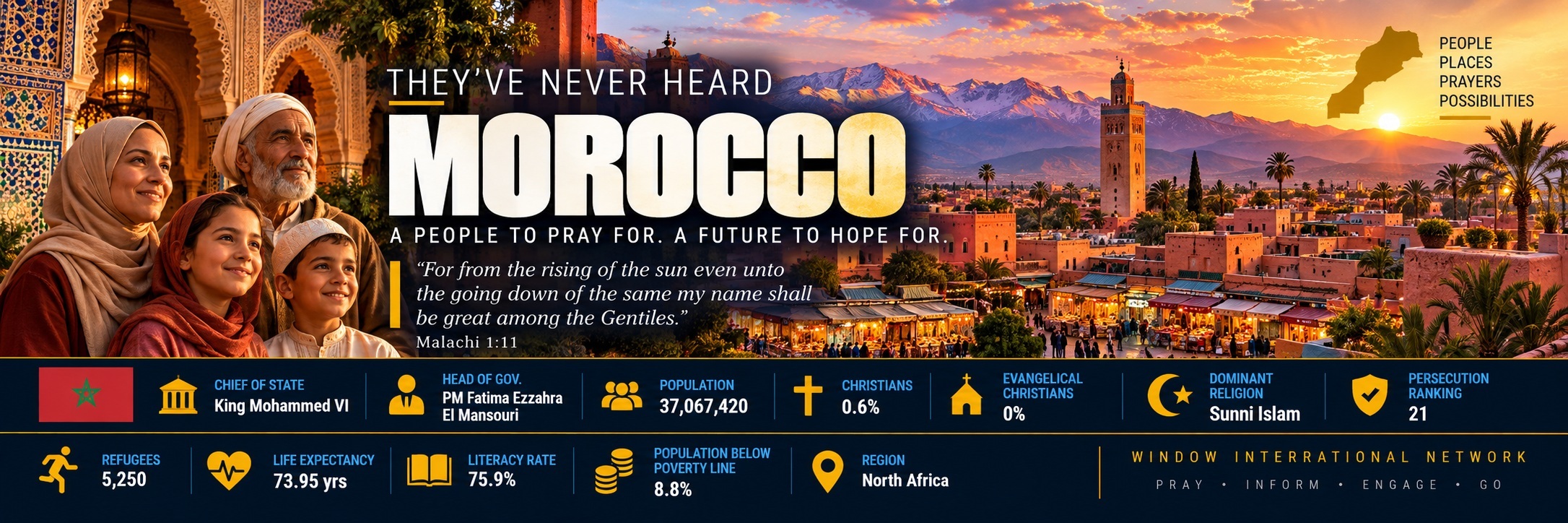
Capital: Rabat
Primary Religion: Islam
People Groups: 29
Unreached People Groups: 27
Unreached Frontier Groups: 23
Morocco stands at the crossroads of North Africa, the Mediterranean, and the Atlantic. Its landscape stretches from major coastal cities to the Atlas Mountains and the vast desert regions of the south. Arabic and Amazigh cultures have profoundly shaped Moroccan identity. Moroccan Arabic is widely spoken, while several Amazigh languages remain important within distinct communities.
The country is overwhelmingly Muslim, while a small Christian presence exists among both Moroccan citizens and foreign residents. Morocco’s people are not a single cultural or linguistic community. There are Arab communities, Amazigh peoples, and smaller communities with their own histories, languages, and traditions.
29 people groups in Morocco, with 27 classified as unreached and 23 identified as unreached frontier groups. The estimates place virtually the entire population within communities classified as unreached.
Among the communities identified are:
- Moroccan Arab communities
- Southern Shilha Amazigh
- Central Atlas Amazigh
- Riffian Amazigh
- various Saharan communities
- Hassaniyya-speaking communities
Some of the smaller communities have almost no known Christian presence. So the challenge is not simply reaching Morocco geographically. The challenge is therefore not simply reaching Morocco geographically. It is reaching people within their own communities, languages, relationships, and cultures. A person can live in a country where Christianity exists and still have little meaningful opportunity to understand the Gospel.
Morocco is a North African nation with a rich cultural heritage shaped by Arab, Amazigh (Berber), and Islamic traditions. Islam is the state religion, and the overwhelming majority of the population identifies as Muslim. Religious identity is closely connected to family relationships, cultural heritage, community belonging, and national history. The country is also home to a small Christian community that includes foreign residents, expatriates, and Moroccan Christians.
Morocco has a long history of Islamic scholarship and religious tradition. Although the country has made efforts to promote religious tolerance and interfaith coexistence, Christian evangelism faces significant legal, social, and cultural challenges. The Moroccan Constitution guarantees freedom of thought, expression, and worship, while also identifying Islam as the religion of the state. The legal framework places restrictions on attempts to convert Muslims to another religion.
For Moroccan Christian Believers who come from Muslim backgrounds, following Jesus can carry personal and social consequences. Some face family rejection, pressure to conceal their faith, or difficulties finding a supportive Christian community. At the same time, access to Scripture, culturally appropriate Christian resources, and opportunities for open religious discussion can be limited.
The challenge for evangelism in Morocco is therefore not simply making the Gospel known. It is sharing the message of Jesus with sensitivity and integrity in a society where religious identity is deeply rooted in family and culture, while supporting those who choose to follow Christ.
Legal restrictions on sharing the Gospel
One of the most significant challenges for evangelism in Morocco is the legal framework governing religious conversion. Article 3 of the Moroccan Constitution establishes Islam as the religion of the state while guaranteeing the free exercise of religious affairs. Non-Muslim communities have opportunities to worship, particularly within established settings, but the legal position of Moroccan Muslims who choose Christianity is more complicated.
Article 220 of the Moroccan Penal Code penalizes certain efforts to induce a Muslim to change their religion when these involve specified means of coercion or exploitation, including exploiting a person’s vulnerabilities to undermine their faith. The law also addresses attempts to prevent or disrupt religious worship through violence or threats. These provisions create legal risks and uncertainty around some forms of evangelistic activity.
As a result, Christian workers must exercise care when distributing religious materials, organizing outreach activities, or engaging in conversations intended to encourage religious conversion. The challenge is to share Christian beliefs respectfully and lawfully while recognizing the distinction between peaceful religious discussion and conduct that may violate local law.
Strong Islamic traditions and cultural identity
Islam is deeply woven into Moroccan family life, festivals, education, community relationships, and national identity. Religious observances such as Ramadan and Eid are important occasions that bring families and communities together. For many Moroccans, Islam is not merely a set of beliefs but an integral part of their cultural heritage and sense of belonging.
When a Moroccan considers following Jesus, the decision may be perceived by family members as a rejection of ancestral traditions. Questions about marriage, family responsibilities, religious celebrations, and the upbringing of children can become particularly sensitive.
This cultural context makes evangelism a matter requiring patience, humility, and understanding. Christians must communicate the Gospel without contempt for Islamic beliefs or Moroccan culture. The challenge is to explain the Christian understanding of Jesus, salvation, and the love of God clearly while treating every person with dignity and respect.
Family rejection and social pressure
For Moroccan Christians from Muslim backgrounds, the decision to follow Jesus can lead to difficult family and community relationships. Some may experience strong opposition, pressure to return to Islam, exclusion from family activities, or concerns about their future marriage and social acceptance. Experiences vary, and not every person who becomes a Christian encounters the same degree of resistance.
In close-knit communities, religious conversion may affect relationships extending well beyond the immediate family. The fear of bringing shame upon relatives or losing social support can discourage people from openly exploring Christianity or identifying themselves as believers.
These pressures can leave new Christians feeling isolated, particularly when they have limited access to other Moroccan believers. The challenge for the Church is to provide compassionate pastoral care, strong fellowship, and opportunities for discipleship while helping believers navigate family relationships with wisdom and love.
Limited opportunities for public Christian worship
Morocco has established churches that serve foreign residents and expatriates, particularly in larger cities. However, access to these churches does not necessarily extend to Moroccan citizens who have converted from Islam. Reports have documented concerns among Moroccan Christians about restrictions on attending established churches, registering Christian communities, and worshipping openly.
Some Moroccan Christian Believers meet privately because they fear social repercussions or unwanted attention from authorities. These circumstances can make regular fellowship, communal worship, and pastoral support difficult to maintain.
The challenge is to strengthen Christian fellowship and provide appropriate pastoral care while respecting local laws. Prayer is needed for opportunities for Moroccan Christians to worship peacefully, gather with other believers, and grow in their understanding of Scripture.
Access to the Bible and Christian resources in local languages
Language is an important consideration in evangelism throughout Morocco. Moroccan Arabic, known as Darija, is widely spoken, while Modern Standard Arabic, Amazigh languages, and French are also used in different settings. People may understand religious concepts differently depending on their language, education, and cultural background.
Although Christian resources exist in Arabic and other languages, finding materials that communicate biblical truths clearly in the language and cultural context familiar to each community remains important. Legal and social sensitivities surrounding evangelistic materials can also complicate their distribution.
The challenge is to help people understand Jesus’ message accurately, including the Christian understanding of His life, death, and resurrection. Christian teaching should address sincere questions with patience and respect, allowing people to explore Scripture without pressure.
Discipleship and the vulnerability of new Christian Believers
For Moroccan Christians who come from Muslim backgrounds, the challenges of faith may continue long after they first encounter the Gospel. Some face family rejection, social isolation, employment discrimination, or difficulties participating openly in Christian life. Reports from Christian organizations have also documented cases of converts being questioned by authorities and pressure on private Christian gatherings.
New believers therefore need more than an initial introduction to Christianity. They need opportunities to study Scripture, receive pastoral guidance, build healthy Christian relationships, and develop a mature understanding of their faith.
Church leaders and Christian workers need wisdom in supporting Moroccan Christian Believers whose circumstances require discretion. The challenge is to nurture spiritual maturity while protecting people’s dignity, respecting their choices, and avoiding actions that could expose them to unnecessary harm.
Social perceptions and the relationship between Christianity and Moroccan identity
Christianity is sometimes viewed as a foreign religion, even though Morocco has a long and varied history of religious communities. This perception can make it difficult for Moroccan Christians to be recognized as part of their own society, particularly when they come from Muslim backgrounds.
Christian evangelism may also be viewed with suspicion when people associate it with foreign influence or believe that material assistance is being used to encourage conversion. Christian organizations must therefore demonstrate transparency and ensure that aid, education, healthcare, and other forms of assistance are never conditional on religious participation or conversion.
The challenge is to demonstrate that Christian witness is grounded in genuine love, honesty, and service. Respectful relationships between people of different faiths can help reduce misunderstanding, while Christians remain faithful to their convictions and treat others with dignity.
Pray for people searching for truth
Pray for Moroccans who are asking questions about God, eternity, purpose, and the meaning of life.
And you will seek Me and find Me, when you search for Me with all your heart.
Jeremiah 29:13
Pray for Morocco’s unreached
Ask God to open doors for the Gospel among communities where there are very few known followers of Jesus.
Declare His glory among the nations,
His wonders among all peoples.
1 Chronicles 16:24
Pray for the Amazigh
Pray that Amazigh communities will encounter the Gospel in ways that respect their languages, cultures, and traditions.
The Gentiles shall come to your light,
And kings to the brightness of your rising.
Isaiah 60:3
Pray for Morocco’s young people
Pray for young adults wrestling with questions about identity, purpose, relationships, and their future.
Show me Your ways, O Lord;
Teach me Your paths.
Psalm 25:4
Pray for refugees and asylum seekers
Pray for protection, dignity, provision, and compassionate people who will stand alongside those far from home.
distributing to the needs of the saints, given to hospitality.
Romans 12:13
Heavenly Father,
We lift up the nation of Morocco into Your loving and sovereign hands. We pray for the Moroccan people, that their hearts may be open to Your truth and that they may encounter the saving grace, peace, and unconditional love of Jesus Christ. Lord, we ask You to open doors for the Gospel throughout this nation, from the bustling streets of Casablanca and Rabat to the villages of the Atlas Mountains and the communities of the Sahara.
May those who are searching for truth, forgiveness, and hope have opportunities to discover Jesus’ message and understand the good news of salvation. Father, we pray especially for Moroccan Christians who have come to faith in Christ from Muslim backgrounds. Strengthen those who face family rejection, social isolation, or pressure to abandon their faith. Give them courage, wisdom, and perseverance, and surround them with faithful Christian Believers who can provide fellowship, encouragement, and sound biblical teaching. Protect those who must navigate difficult personal circumstances because of their convictions, and grant them peace as they seek to follow You.
Lord, we pray for pastors, Christian workers, and Christian Believers who faithfully serve in Morocco. Equip them to communicate Your Word with humility, integrity, and cultural sensitivity. Provide access to Scripture and appropriate Christian resources in Moroccan Arabic, Amazigh languages, and other languages spoken throughout the country. Raise up mature local Christian Believers who can disciple others and demonstrate Christ’s character in their daily lives.
Father, we pray for Morocco’s leaders and authorities, asking that You grant them wisdom to uphold justice, protect freedom of conscience, and allow people to explore matters of faith peacefully and without coercion. May laws and practices protect the dignity of all people and provide space for peaceful religious expression. We pray for young people and families who are seeking answers about life’s purpose, suffering, forgiveness, and eternity. May they encounter Your truth and experience the hope that comes through Christ.
We also remember migrants and expatriates who live far from their families, asking You to provide for their needs, protect the vulnerable, and strengthen Christian fellowships that serve them. Lord, remove barriers of fear, misunderstanding, and hostility between people of different faiths. Help Christians to be known for their love, compassion, honesty, and willingness to serve others without discrimination. May friendships be built on mutual respect, and may acts of kindness reflect Your goodness to the Moroccan people.
Holy Spirit, move throughout Morocco, bringing hope to the discouraged, comfort to the lonely, courage to Your people, and opportunities for people to encounter the Gospel. Strengthen Your Church, deepen the faith of Moroccan Christian Believers, and raise up faithful witnesses who will share the good news with grace and truth. May the light of Jesus Christ shine throughout this nation, and may many come to know His love and Salvation. We entrust Morocco and its people to Your mercy, asking that Your peace, wisdom, and truth may prevail.
In the mighty and precious Name of Jesus Christ, we pray. Amen.

