Pray for the cities
Pray for Baghdad, Mosul, Basra, Erbil, Kirkuk, Najaf, and the many smaller cities and towns scattered across Iraq.
Lord Jesus, bring peace and flourishing to Iraq’s cities. Place your people in workplaces, universities, neighborhoods, and businesses where relationships can become bridges for the Gospel.
The Lord is my strength and my shield; My heart trusted in Him, and I am helped; Therefore my heart greatly rejoices, And with my song I will praise Him.
Psalm 28:7
Pray for Iraqi Christians to remain faithful
Pray for Christians who feel pressure to leave their homeland. Pray for those who remain.
Pray for pastors, priests, evangelical leaders, and ordinary Christian Believers.
Lord Jesus, strengthen Iraqi Christian Believers. Give them the courage to remain faithful and the wisdom for every decision about their families and their future.
Be of good courage,
And He shall strengthen your heart,
All you who hope in the Lord.
Psalm 31:24
Pray for the next generation
Many Iraqi children and young adults have grown up knowing conflict, displacement, or instability. Pray that an entire generation will discover that their identity does not have to be defined by the wounds of the past.
Father, speak to Iraq’s young people. Give them wisdom, purpose, and hope. Raise up a generation that seeks truth and pursues peace.
So teach us to number our days,
That we may gain a heart of wisdom.
Psalm 90:12
Pray for the Yazidi people
Remember Yazidi families who continue to live with the consequences of the violence they experienced.
Pray for survivors, families separated by displacement, and communities rebuilding their lives.
Heavenly Father, bring healing to Yazidi families. Restore dignity where it has been violated and bring comfort where memories still cause pain.
He heals the brokenhearted
And binds up their wounds.
Psalm 147:3
Pray for ancient Christian communities
Pray for Assyrian, Chaldean, Syriac, and other historic Christian communities. Pray that their ancient heritage will not merely become something remembered in museums and history books.
Lord Jesus, preserve Your people in Iraq. Let historic churches become communities of living faith, compassionate service, and courageous witness.
The Lord shall preserve you from all evil;
He shall preserve your soul.
Psalm 121:7
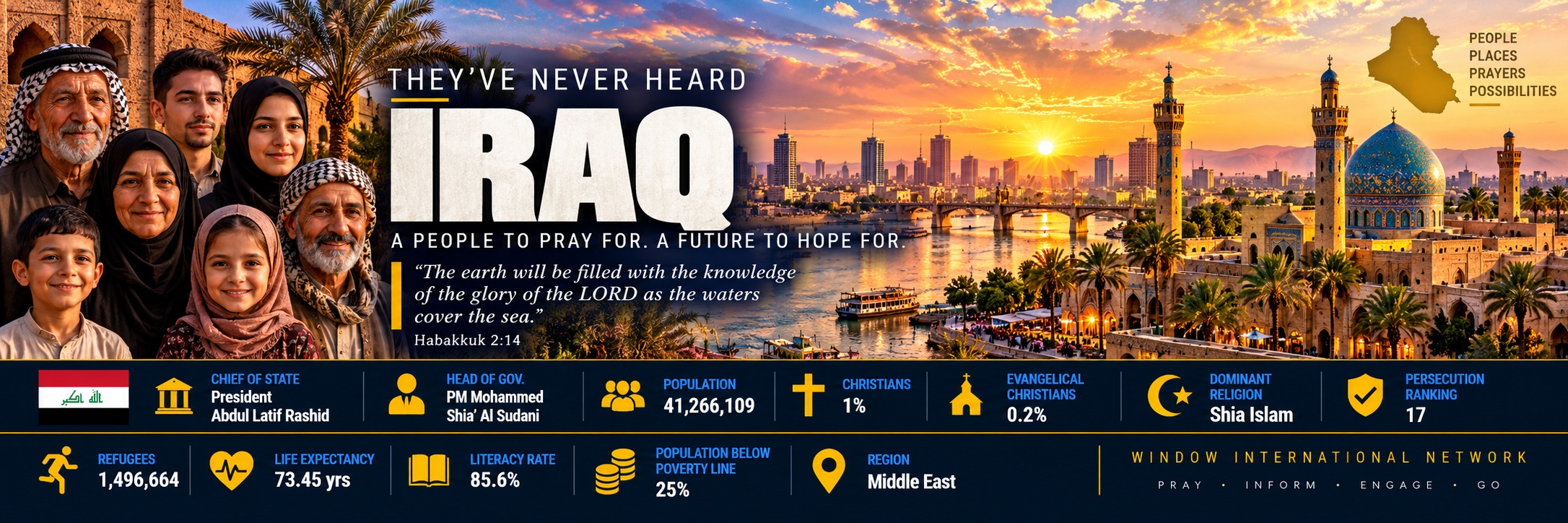
Capital: Baghdad
Dominant religion: Islam — predominantly Shia, with a large Sunni population
Languages: Arabic and Kurdish; Turkmen and Syriac also have official recognition in areas where they are traditionally spoken
Iraq is ancient. This is the land of Mesopotamia, the region between the Tigris and Euphrates Rivers. Cities such as Baghdad, Mosul, Basra, Erbil, and Najaf carry layers of history that reach back thousands of years. Iraqis fill its markets, universities, farms, workshops, and offices. Families gather around meals. Children play in the streets and courtyards. Students dream about careers. Parents worry about their children’s future.
The country is also remarkably diverse. Alongside its large Arab and Kurdish populations are Turkmen, Yazidis, Assyrians, Chaldeans, Syriac Christians, Shabaks, Kaka’i/Yarsani, Sabean-Mandaeans, Armenians, and other communities.
Arab Iraqis
Arab communities form the majority of Iraq’s population and include both Shia and Sunni communities. They live across the country—from Baghdad and the central plains to Basra in the south and communities along the Euphrates.
Kurdish Iraqis
Kurdish communities are concentrated particularly in the north and northeast, including the Kurdistan Region. Kurdish identity itself encompasses different linguistic and cultural traditions.
Turkmen
Iraqi Turkmen communities have a long history, particularly around Kirkuk, Ninewa, and other northern areas.
Yazidis
The Yazidi community is historically concentrated around Sinjar and the Ninewa region. The community suffered catastrophic violence under ISIS, including killings, enslavement, and mass displacement.
Assyrian, Chaldean, and Syriac Christians
These communities represent some of the oldest continuous Christian traditions in the region. Christianity has existed in Mesopotamia since the earliest centuries of the Church. Yet the survival of ancient Christian communities does not mean that every Iraqi community has access to a vibrant Christian witness.
Sabean-Mandaeans
A small community traditionally concentrated around southern Iraq and Baghdad, the Sabean-Mandaeans have faced severe demographic decline and displacement.
Shabaks and Kaka’i
These smaller communities are particularly associated with northern Iraq, particularly the Ninewa area, and have their own distinctive religious and cultural identities.
There are communities across Iraq where the Christian witness remains limited, fragile, or difficult to access.
Among those needing sustained prayer are:
- Arab communities with little meaningful Christian witness
- Kurdish communities with limited access to evangelical churches
- Iraqi Turkmen
- Shabak communities
- Kaka’i/Yarsani communities
- Yazidi communities
- Sabean-Mandaean communities
- Muslim communities in areas where Christian witness is difficult
- Younger generations who have grown up amid conflict and displacement
Religious and legal restrictions on conversion
Islam is deeply embedded in Iraq’s social and political life, and the legal environment presents particular difficulties for Muslims who wish to become Christians. Although the Iraqi Constitution guarantees freedom of religion and belief, it also designates Islam as the official religion and prohibits the enactment of laws that conflict with its provisions.
Christian communities also operate within a legal framework that regulates religious institutions and personal-status matters. The result is an environment in which individuals may have difficulty publicly identifying with Christianity, particularly if they come from Muslim backgrounds.
The challenge for evangelism is to make Jesus’ message known in ways that respect the law and the freedom of conscience of every individual, while praying for greater protection for those who choose to follow Christ.
Strong Islamic traditions and family expectations
For many Iraqis, Islam is closely connected to family heritage, cultural identity, community belonging, and social relationships. Religious traditions shape important aspects of everyday life, including marriage, celebrations, family responsibilities, and community expectations.
A person who considers Christianity may therefore face more than a theological decision. Conversion can be perceived as rejecting family traditions or abandoning the community into which the person was born. Relatives may fear social stigma, family conflict, or exclusion from established networks of support.
These pressures can be particularly difficult in close-knit communities where religious identity is shared across generations. Some individuals may be reluctant to explore Christianity openly because they are uncertain how their families will react.
The legacy of ISIS and persecution
The emergence of ISIS in 2014 brought catastrophic consequences for Iraq’s Christian population, particularly in the Nineveh Plains and surrounding areas. Christian families were driven from their homes, churches and monasteries were damaged or destroyed, and many people experienced killings, abductions, threats, and the loss of property.
Although ISIS lost its territorial control in Iraq, the consequences of its violence remain significant. Many displaced Christians emigrated permanently, while others returned to communities where rebuilding homes, restoring livelihoods, and recovering a sense of security have taken years. The destruction of historic churches and the displacement of families also disrupted longstanding networks of Christian fellowship.
This history continues to shape how some Iraqis view religious differences, religious minorities, and Christian outreach. In communities that have experienced violence, evangelism must never be insensitive to suffering or appear to exploit people’s vulnerability.
The challenge is to bear witness to Christ through compassion, reconciliation, practical service, and a commitment to the dignity of every person. Prayer is needed for healing among survivors, restoration for displaced families, and lasting protection for religious minorities.
Security concerns and continuing instability
Although the territorial defeat of ISIS reduced one major threat, Iraq continues to face security challenges in some areas. The presence of armed groups, political tensions, localized violence, and unresolved disputes over property and governance can affect religious minorities and the communities in which they live. Insecurity and harassment continue to threaten religious minorities, including Christians.
These conditions can make ministry difficult, especially in areas where churches have been damaged, Christian families remain displaced, or Christian Believers are concerned about their personal safety. Christian workers may need to adapt their activities to local circumstances, and congregations may struggle to maintain regular worship and outreach.
The displacement and emigration of Christian communities
One of the most serious challenges facing Christianity in Iraq is the continuing decline of historic Christian communities. Violence, economic hardship, insecurity, property disputes, and limited confidence in the future have encouraged many Christian families to leave the country. Some communities that once had a strong Christian presence have experienced substantial population loss.
The Nineveh Plains, which contain several historic Christian towns and villages, illustrate this challenge. Although reconstruction and return efforts have helped some families, security concerns and unresolved property issues continue to hinder the safe return of others.
This emigration affects more than population numbers. It can leave churches with fewer young people, reduce the number of trained local leaders, weaken Christian educational and social institutions, and fragment families across different countries.
Sectarian divisions and mistrust between communities
Iraq’s religious landscape includes Shia and Sunni Muslims, historic Christian communities, Yazidis, Mandaeans, and other religious and ethnic groups. Political competition, past violence, and discrimination have contributed to mistrust between some communities. Christians may also face difficulties when religious identity intersects with ethnic divisions, local power struggles, or disputes over land and representation.
In this environment, evangelism can be misunderstood if it is associated with foreign political interests or viewed as an attempt to exploit social divisions. Christian organizations need to demonstrate that their purpose is spiritual and humanitarian rather than political.
Legal recognition and the protection of religious minorities
Iraq’s Constitution recognizes freedom of religious belief and practice, including for Christians. However, legal and administrative challenges remain. Personal-status provisions can create serious obstacles for people who leave Islam, while blasphemy laws and disputes over religious recognition can affect the exercise of religious freedom. The legal position and practical experience of religious communities can also differ between federal Iraq and the Kurdistan Region.
For Christians from Muslim backgrounds, the consequences may include difficulties with official identity records, marriage, inheritance, or family status. Some evangelical communities have also reported challenges relating to official recognition and perceptions of proselytism.
Pray for the Gospel to reach Iraqi families
Pray for households that have never had a meaningful conversation about Jesus.
Father, bring Your light into Iraqi homes. Open doors for conversations about Jesus, and give Christian Believers wisdom to speak with grace and truth.
Your Word is a lamp to my feet
And a light to my path.
Psalm 119:105
Pray for Muslim neighbors to encounter Jesus
Iraq’s Muslim majority represents tens of millions of people.
Lord Jesus, reveal Yourself to Iraqis who are seeking truth. Give them opportunities to encounter the Gospel and people who will answer their questions with humility and love.
“Ask, and it will be given to you; seek, and you will find; knock, and it will be opened to you.
Matthew 7:7
Pray for a multiplying Iraqi Church
Pray for disciples who will make disciples. Pray for churches that develop local leaders.
Pray for Christian Believers who can carry the Gospel into communities where there is currently little Christian witness.
Father, raise up Iraqi disciples who will carry the Gospel from home to home and generation to generation. Let what begins quietly become a movement of faithful discipleship.
Those who sow in tears
Shall reap in joy.
Psalm 126:5
Heavenly Father,
We lift up the nation of Iraq into Your loving and sovereign Hands. We pray for the Iraqi people that they may experience Your peace, healing, and hope after decades of conflict, violence, displacement, and suffering. Lord, open hearts throughout this ancient land to the truth and saving grace of Jesus Christ, so that those searching for forgiveness, meaning, and eternal hope may encounter the Gospel and discover Your unfailing love.
Father, we pray especially for Iraq’s historic Christian communities, including the Chaldean, Assyrian, Syriac, and other churches that have faithfully preserved their Christian heritage through generations of hardship. Strengthen their faith, protect their congregations, and restore the communities devastated by violence and persecution. Remember the families displaced from their ancestral homes, those who have lost loved ones, and those who continue to live with fear and uncertainty. Provide for their needs, heal their emotional wounds, and give them hope for the future.
Lord, we pray for Christians who have come to faith from Muslim backgrounds and who may face rejection, isolation, or pressure because of their convictions. Grant them courage, wisdom, and perseverance, and provide them with trustworthy Christian fellowship, sound biblical teaching, and compassionate pastoral care. Protect their privacy and safety, and strengthen them to grow in their relationship with You. We also pray for pastors, church leaders, missionaries, and Christian workers throughout Iraq. Equip them to serve with humility, discernment, and love.
Raise up a new generation of Iraqi Christian leaders who will teach Your Word faithfully, disciple Christian Believers, and minister to their communities with compassion. Provide opportunities for people to access Scripture and appropriate Christian resources, and strengthen churches as they seek to rebuild their lives and ministries. We also pray for Iraq’s government and all those in positions of authority. Grant them wisdom to govern with justice, protect religious minorities, uphold freedom of conscience, and ensure that all citizens can live without fear of discrimination or violence. Bring an end to sectarian hatred, political instability, and the activities of extremist groups. Help people from different religious and ethnic backgrounds to live together in peace, mutual respect, and understanding.
Lord, remember the younger generation of Iraq, especially those who have grown up amid war, displacement, and uncertainty. Provide opportunities for education, employment, and a hopeful future. Comfort those who grieve, strengthen those who feel forgotten, and restore the dignity of those who have suffered injustice. May Your Church become an instrument of reconciliation, demonstrating the love of Christ through practical service, forgiveness, and genuine concern for every person.
Holy Spirit, move throughout Baghdad, the Nineveh Plains, Mosul, Erbil, Basra, and every region of Iraq. Bring healing to wounded hearts, restoration to broken communities, protection to vulnerable families, and spiritual renewal to Your people. Open doors for the Gospel to be shared peacefully and respectfully, so that many may come to know Jesus Christ as Lord and Savior. We entrust Iraq and all its people to Your mercy, asking that Your peace may overcome hatred, Your light may overcome darkness, and Your love may bring hope to this ancient land. May Iraq be held in Your loving care, and may Your peace, presence, and protection remain with its people.
In the mighty and precious Name of Jesus Christ, we pray. Amen.

